Why Brand Visibility Matters More Than Ever in AI Search
VCentrix Admin
Author
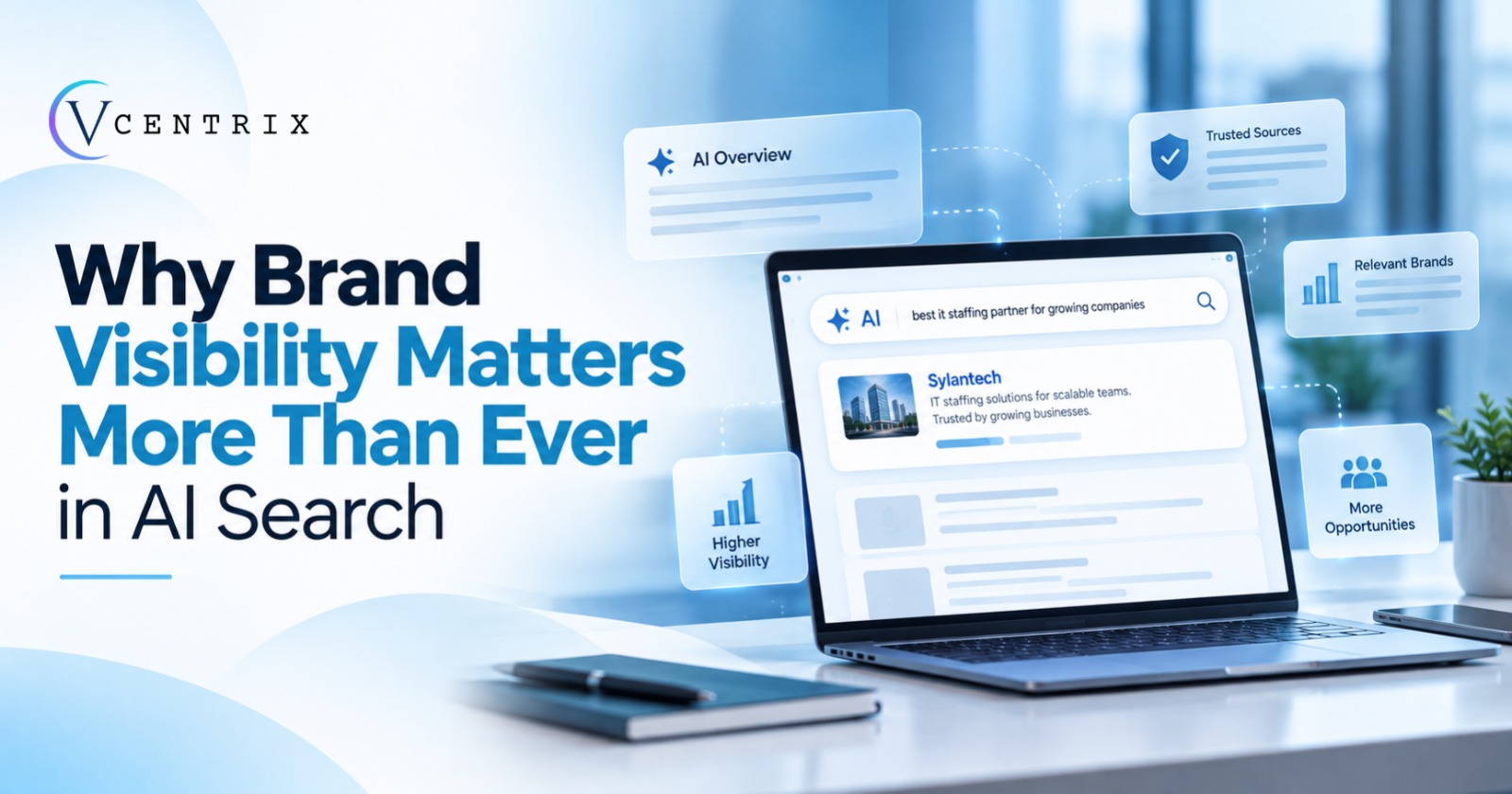
Why Brand Visibility Matters More Than Ever in AI Search
The way people find brands has changed
For two decades, brand discovery followed a familiar path: a customer typed a query into a search engine, scanned ten blue links, and clicked through to a few websites. Your job as a marketer was to rank as high as possible on that page.
AI search has rewritten that path. Tools such as ChatGPT, Gemini, Perplexity, Claude, and the AI summaries now appearing at the top of traditional search results do not hand people a list of links to sort through. They synthesise an answer, often naming a handful of brands, products or sources directly in the response. The user may never visit a single website.
That changes what visibility means. It is no longer enough to rank. Your brand has to be recognised, understood and recommended by the systems that now sit between you and your customer.
Fewer clicks, higher stakes
When a search results page offers ten links, there is room for many brands to earn a share of attention. An AI-generated answer typically mentions only a few. If your brand is not among them, it is effectively absent from that moment of decision.
This compresses the competitive field in two ways:
Fewer slots. AI answers favour a short list of options, so the gap between being included and being left out is wider than the gap between position three and position seven on a results page.
Fewer clicks. When the answer is delivered directly, users have less reason to click through. Influence happens inside the response, before a visit to your site ever occurs.
For brands, this means visibility is increasingly measured by mentions, citations, and the way you are described, not only by traffic.
Trust is now a ranking signal you have to earn
AI systems are built to produce answers that feel reliable. To do that, they lean on sources and entities that appear credible, consistent, and well corroborated across the web. A brand with a clear identity, accurate information, and a footprint of trustworthy mentions is easier for these systems to recommend with confidence.
A brand that is vague, inconsistent, or thinly documented is harder to recommend, and may be skipped altogether or described inaccurately. In other words, your reputation is not just a perception among humans anymore. It is also data that shapes what machines say about you.
What drives brand visibility in AI search
No one outside the platforms can claim to know exactly how each AI system chooses what to surface, and the behaviour of these tools continues to evolve. But several factors consistently contribute to a brand being understood and cited:
Clear, consistent brand information. Your name, what you do, who you serve, and how you differ should be stated plainly and identically across your website, social profiles, directories, and press mentions.
Authoritative, helpful content. Original insight, genuine expertise, clear explanations, and direct answers to the questions your customers actually ask give AI systems something worth drawing on.
Third-party validation. Reviews, media coverage, industry mentions, partnerships, case studies, and expert commentary show that others vouch for you, not just yourself.
Well-structured, accessible content. Clean site architecture, descriptive headings, FAQs, and structured data help both search engines and AI tools interpret your pages correctly.
Topical depth. Brands that consistently publish across the full range of a subject tend to be seen as credible sources on it, rather than as one-off voices.
Presence beyond your own website. AI answers often reflect conversations and sources from across the web, including forums, communities, publications, and video, so showing up where your audience and your industry already talk matters.
From SEO to a broader visibility mindset
Traditional SEO is not obsolete. Search engines remain a major gateway, and the fundamentals of good technical health, relevant content and quality links still support discoverability, including in AI-assisted results. But SEO alone is no longer the whole picture.
The emerging discipline, sometimes called generative engine optimisation or AI search optimisation, extends the focus from keywords and rankings to entities, context and credibility. The question shifts from "How do we rank for this phrase?" to "When someone asks an AI about our category, are we part of the answer, and is the answer accurate?"
Practical steps to strengthen your visibility
You do not need to overhaul your marketing overnight. A sensible starting point looks like this:
Audit how AI describes you. Ask major AI tools about your brand, your category, and your competitors. Note whether you appear, how you are described, and what is wrong or missing.
Fix the foundation. Make sure your website, business profiles, and listings carry accurate, consistent details about who you are and what you offer.
Answer real customer questions. Build content around the questions your buyers ask, written clearly and directly, with genuine expertise behind it.
Earn credible mentions. Invest in PR, partnerships, thought leadership, reviews, and customer stories that put your name in trusted places.
Make content easy to interpret. Use clear headings, concise summaries, FAQs, and structured data so machines can parse your pages.
Keep it current. Outdated pricing, services or claims can be repeated by AI systems long after they stop being true. Refresh key pages regularly.
Track the right signals. Alongside rankings and traffic, monitor brand mentions, citations in AI answers, branded search growth, and the sentiment of how you are described.
Mistakes to avoid
A few pitfalls are worth steering clear of. Publishing large volumes of generic, AI-written filler adds noise rather than authority. Chasing short-term tricks to manipulate AI outputs is risky, since platforms are continually refining how they evaluate sources. And ignoring accuracy, such as letting incorrect information about your brand circulate unchecked, can quietly erode trust at scale.
The most durable approach is also the simplest: be genuinely useful, be clear about who you are, and be credible in the places that matter.
Why this matters for every brand, not just big ones
AI search can level the field in interesting ways. A smaller brand with a sharp point of view, strong expertise, and well-documented credibility can be cited alongside, or even ahead of, larger competitors that have a bigger budget but a muddier message. Visibility is increasingly earned through clarity and authority rather than sheer scale.
The flip side is that brands that wait risk falling behind. As more customers begin their research inside AI tools, the brands that are already well understood by those systems will be the ones that get recommended first.
Conclusion
AI search is changing how customers discover, compare, and choose brands. With fewer clicks and fewer names in each answer, the cost of being invisible is higher than it has ever been, and the reward for being trusted and clearly understood is greater.
The path forward is not to abandon what has worked, but to build on it: strengthen your brand's clarity, publish content that earns credibility, and make sure the story AI tells about you is accurate. In a world where the answer often comes before the click, brand visibility is no longer just a marketing goal. It is a foundation for growth.